"THE
COMMISSAR" "КОМИСАР"
This assignment relies on two excerpts from the controversial
1967 Soviet film "The Commissar" as well as two reviews of the film to examine
themes and issues associated with the crucial formative stage of Soviet
history, the Civil War era, 1918-1921, in five steps.
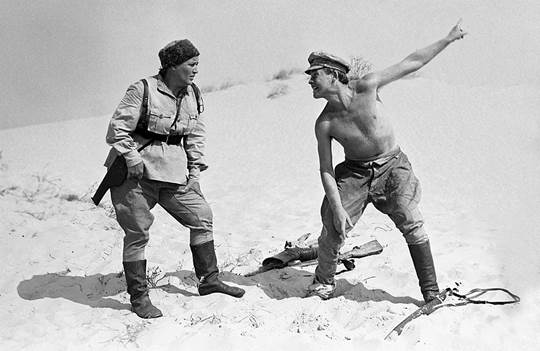
Based on Vasily Grossman's 1934 novella In the Town of Berdichev and directed by Aleksandr Askoldov, the
surrealistic 1967 Russian film "The Commissar" (Комисар)
follows a female Commissar or political officer in the Soviet Red Army during
the Civil War, 1918-21. The Commissar, Klavdia Vavilova, becomes pregnant due to a dalliance with an
officer at the front and Soviet authorities send her to live with a Jewish
family in the Ukrainian countryside as the Whites, the opposing army in the
Civil War, close in. It is set in 1919 at a
time when the Whites were on the offensive from the South and the Reds were
forced to retreat toward Moscow. The KGB seized the film
when it was completed in 1967 and banned it due to its portrayal of a Commissar
in the Red Army becoming pregnant, a serious dereliction of duty; due to the
film's implications of the Red Army's failure to protect Jews from the threat
of pogroms by the White Army as well as its hints of Soviet/Russian/Ukrainian
anti-Semitism; and also due to the film's surrealistic style, which went
against the approved "socialist realism" genre for Soviet art in this period. Askoldov, meanwhile, was banned from ever making another
feature film. The film was finally shown for the first time in December 1987,
twenty years after its creation, during Soviet leader Mikhail Gorbachev's glasnost or "openness" reforms.
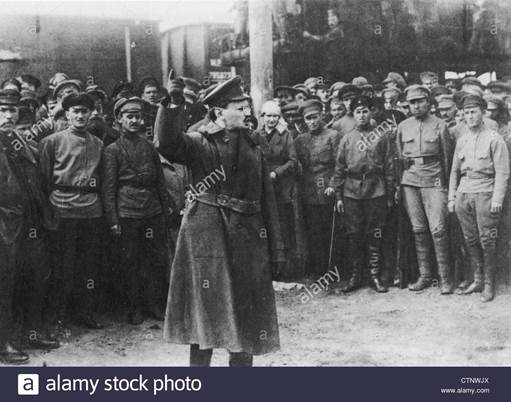
Leon Trotsky,
Soviet Commissar of War, makes a rousing speech to Red Army soldiers during the
Civil War in 1919.
Leon Trotsky as
Soviet War Commissar created the position of the political Commissar, a leading
figure in Red Army units whose rank equaled that of the military commanders of
the units. Trotsky did so to improve the morale of the soldiers fighting for the
communist forces because many of the military commanders themselves had been
officers in the tsarist army and thus were, from Trotsky's point of view, of
suspect loyalty to the communist cause. As devout communist believers
Commissars were in charge of the political education of the troops as well as
of maintaining discipline. For example, at the beginning of the film the
hardline Vavilova orders the execution of a Red Army
soldier who deserted but is caught visiting his wife in his home village, which
is ironic given her own (as yet unannounced) pregnant condition at the time.
Thus a Commissar = a Red Army
political officer or propagandist/communist party member assigned to Red Army units to "maintain discipline" and carry
out political orders. There were
several women Commissars enlisted in the Red Army during the Civil War.
|
|
|
|
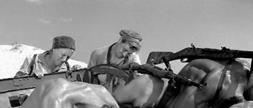
STEP 1: Read these two brief reviews
of the film.
The following two excerpts
from "Commissar" are a total of 21:03 in length and come from different points
in the film.[NOTE: you will need to log-in using your uncg.edu email address
to view the clips]. In this first scene pay attention in particular to the
symbolism conveyed (bear in mind for example that a rider-less horse represents
a fallen soldier) and consider the following questions as you watch:
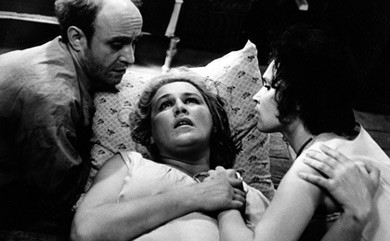
- How might you interpret this birth scene and its dream sequences metaphorically (i.e. it is clearly not an easy birth—what do you think that might mean?)
- What gender is the newborn baby and why might that be significant?
- As we know from one of Vavilova's dream sequences during her difficult labor, what happened to the father of her child?
STEP 2: View the first
excerpt from the film, the
birth scene (13:22).
In this second
scene two Red Army officers from her old unit come to pay Vavilova
a visit, bring her some news, and also some supplies as she cares for her
newborn baby in her host family's home. As you watch consider the following
questions:
- How do you interpret the beginning of this clip?
- What is Vavilova doing when the Red Army officers arrive? What news do they bring and why does this worry Vavilova with regard to her Jewish host family?
- Why do you think it is significant that Vavilova points out one of the officers has a gold watch? Also, what supplies do they bring for Vavilova and her host family?
STEP 3: View the second excerpt, the visit (7:41).

STEP 4: Write up brief (1-2 sentence) responses for each of the
questions listed above for the two clips.
|
|

STEP 5: Read this brief interpretation
of the two clips. Do you agree or disagree with the points raised? Why or why
not? Add a 1-3 sentence response to your write-up to turn in.
OPTIONAL: feel free to watch entire film "The Commissar" (80
mins.) on RVISION