KOMISSAR - Film (Movie) Plot and Review
Source: Film
Reference
Cast: Nonna Mordyukova; Rolan Bykov; Lyudmila Volynskaya; Vasily Shukshin; Raisa Nedashkovskaya
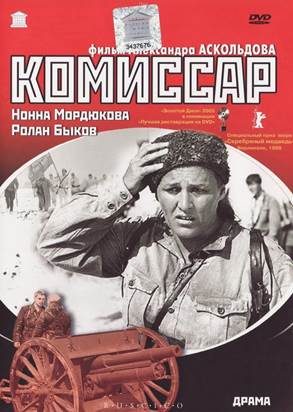 When
director Aleksandr Askoldov
completed his first and only feature, The Commissar, in 1967, it was
immediately banned and he was blacklisted as a film director. In December of
1987, in an atmosphere of glasnost, The Commissar was permitted a
showing in Moscow and soon received international attention and critical
praise. The film, based on the story "In the Town of Berdichev"
by Vasily Grossman, is about love, war, maternity and
betrayal, and presents a frightening foreshadowing of the Holocaust.
When
director Aleksandr Askoldov
completed his first and only feature, The Commissar, in 1967, it was
immediately banned and he was blacklisted as a film director. In December of
1987, in an atmosphere of glasnost, The Commissar was permitted a
showing in Moscow and soon received international attention and critical
praise. The film, based on the story "In the Town of Berdichev"
by Vasily Grossman, is about love, war, maternity and
betrayal, and presents a frightening foreshadowing of the Holocaust.
The pregnant commissar of a Red Army unit, Klavdia Vavilova, enters the town
of Berdichev at the head of her battalion and shoots
a deserter who
had escaped home to his wife. While occupying the town, this hard-edged,
dedicated Bolshevik must tell her second-in-command that she must leave the
Army because she is pregnant. The home of a Jewish tinsmith and his wife,
mother-in-law and six children is commandeered for her confinement, and the
commissar and her baby become assimilated into this family. A friendship
develops between Klavdia and Raisa, the tinsmith's
wife, and both begin to adopt characteristics of the other. After her baby is
born, the commissar becomes nurturing, gentle, and protective of her child,
while, Raisa, the tinsmith's wife, begins to assert her individuality.
Realizing the fragility of new life and responsibilities of motherhood, Klavdia questions whether the consequences of war are too
costly for her to return to battle. She finally decides to resume her duties as
commissar and leaves her infant with the Jewish family.
The film has elements of warmth and humor as the
tough commissar clashes with the gentle tinker, and as they eventually develop
a strong bond. The large loving family represents a nurturing Jewish ethic,
which Askoldov contrasts with the uncompromising
Russian will to conquer in the name of universal justice. The Jewish family is
treated sympathetically, but as William Wolf asserts in Film Comment,
"Paying special attention to the persecution of Jews has long conflicted
with the Soviet policy
of downplaying Jewish identity."
The film was banned due to tension derived from
the Soviet Union's troubled history with Jews and Askoldov's
refusal to change or remove any part of the film which exposes anti-Semitism
and portrays the military unfavorably. Anne Williamson stated in Film
Comment (May/June 1988): "In 1967, just as Israel had triumphed in the
Six Day War, Askoldov was finishing the edit on The
Commissar, which sympathetically portrays a Jewish family. Soviet censors realized
that scenes like the commissar's vision of the future Holocaust and of the Magazanik family being led to the gas chambers hinted
darkly at a connection between Nazism and Russian anti-Semitism and could possibly remind
audiences of Stalin's appeasement of
Hitler." In addition to the powerful flash forward of the family members
trudging along to their impending terrifying demise, the film includes a
disturbing child's fantasy of a pogrom. As Louis Menashe suggests in Cineaste,
1989, "What appears to be Askoldov's preference
for humanism over Bolshevism probably
contributed to official wrath toward the film."
The Commissar was produced at the Gorky Studio, which rejected the finished
product as its "greatest political and esthetic failure." Askoldov was
fired for incompetence and the film was destroyed. But Gorbachev's policy of glasnost
led to a revolution in Russia's film industry and many blacklisted films
reemerged. In May, 1986, conservatives were ousted from the leadership of the
Soviet Filmmakers Union and control over the movie industry shifted from the
state bureaucracy to the union's new leaders—directors whose films had been
shelved in the past. Askoldov was given permission to
search for his film in the state archives, and he found a print in a damp
cellar. The black-and-white film had been partially destroyed, but Askoldov restored it by piecing together various copies.
The Commissar is visually striking and incorporates features of Askoldov's great predecessors. Williamson identifies a
brilliant metaphor in the cross-cutting of soldiers and sees Vsevolod Pudovkin's sense of
realism as Klavdia struggles to push a cannon up a
hill of sand and in the birth sequence. The rhythm and energy of Sergei Eisenstein are evoked
in the scene of the caravan in which the commissar's revolutionary lover dies a
gallant death. Brian Johnson notes in his article in Maclean's (26
September 1988): "Askoldov broke the fetters of
the socialist realism that prevailed at the time of the film's release with
fluid camerawork and dreamlike scenes of cavalry horses galloping riderless across a battlefield." The clarity of the
images and varying pace of editing offers moments enhanced by an excited tempo
as well as those reserved for reflection and contemplation.
—Kelly Otter
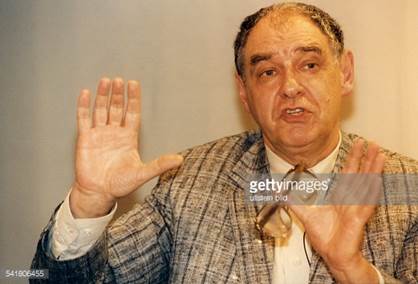
Soviet film director
Aleksandr Askoldov
"Komissar" – 1967, Aleksandr Askoldov
Source: February 28, 2012 by wondersinthedark

by Allan Fish (USSR 1967 108m)
The film won
the Silver Bear-Special Jury Prize at the 38th Berlin International
Film Festival in 1988 and several other international awards as well.
Aka "The Commissar"
The trams will
never be running
He was only a
boy of five when he became an effective orphan. Hard to imagine, having to
stand back and watch your mother taken away by officials (and your father,
veteran of the eastern front and the Civil War having 'gone ahead' [as victims
of the Stalinist purges in 1939]), and to hear the words "come back for the
boy later." Credit to the boy for having the gumption to realise that he needed to get out of there, even though it's
not yet dawn and dark outside, and make his way to the house of friends of his
parents, where he was hidden—[with a Jewish] family
[who] years later [would] themselves disappear in the Holocaust.
Thirty years
later that little boy Aleksandr was making his first
film, so it's more than understandable what events in his life would influence
him. He took a propagandist story by Vasily
Grossman and transformed it into a film which would prove the most incendiary
Soviet work of its generation. It was dismissed, booed, banned and derided
upon its first showing, Askoldov himself not only
losing his director's license but being thrown out of the party. He could
so easily have been made to 'disappear' himself, but he hung in there, amidst
the derision.
Then in the
late eighties came Glasnost and so
many films shelved by the Soviet authorities during the Cold War were given the
light of day and a projector . . . and all were enthusiastically
received. Yet it wasn't until a Moscow Film Festival, when Askoldov himself had to witness the lie that all banned
films were now liberated, that he spoke up and told the masses of western press
and filmmakers that there was one film that wasn't seen. Finally, it would
begrudgingly get its day in the sunlight. The day became weeks, months,
awards from film festivals and august bodies alike, but still he was never
allowed to make another film.
In itself it's
a simple tale, of a Red Army cavalry officer who just happens to be a woman,
and a pregnant woman, too. How she came to be pregnant and who is left to
her own delirious dreams in the throes of labor, what's important is how she
comes to stay with a Jewish family and question the very nature of the
superiority of an ideology.
There hadn't
been many pictures of real note about the Russian Civil War . . . so the
subject itself is arresting from the start. And what an opening; a
boy wandering around a desert town with its Russian Orthodox church in a way to
make it look like a Borsch western. Those visuals give way to a style, if
not rhythm, that owed more to [Hungarian surrealistic film director Miklós] Jancsó, such as an
extended sequence of cavalry horses running past abandoned ploughs to the
incessant accompaniment of machine gun fire. In another scene, siblings
play at re-enacted pogroms in a way to make the blood turn cold. Yet even
that pales beside the sequence when the screen turns red in hue, tinting like
in the old silent [films]. The symbolism of blood becomes crystal
clear. In what may be a premonition or merely a nightmare, the woman
imagines hordes of Jews being shepherded into a narrow gateway. Men in
painfully familiar striped pajamas look down on them. Back to monochrome
outside the Jewish family's house, windows and doors boarded up with crossed
planks, images of an earlier culling, of the red crosses of the great plagues
of centuries earlier, while [the Commissar's] emergence from a shelter
underground had undoubted resonance in the Cold War; a nuclear winter for a
time when it wasn't even in the vocabulary. It's a deeply humanistic film
from a society which repudiated it. "There's so few kind people left in
the world", Yefim says. . . .
